
— Article
Five people, zero drone experience, 3.5 months: how we took 2nd place at the MBDA Swarm Drone Challenge
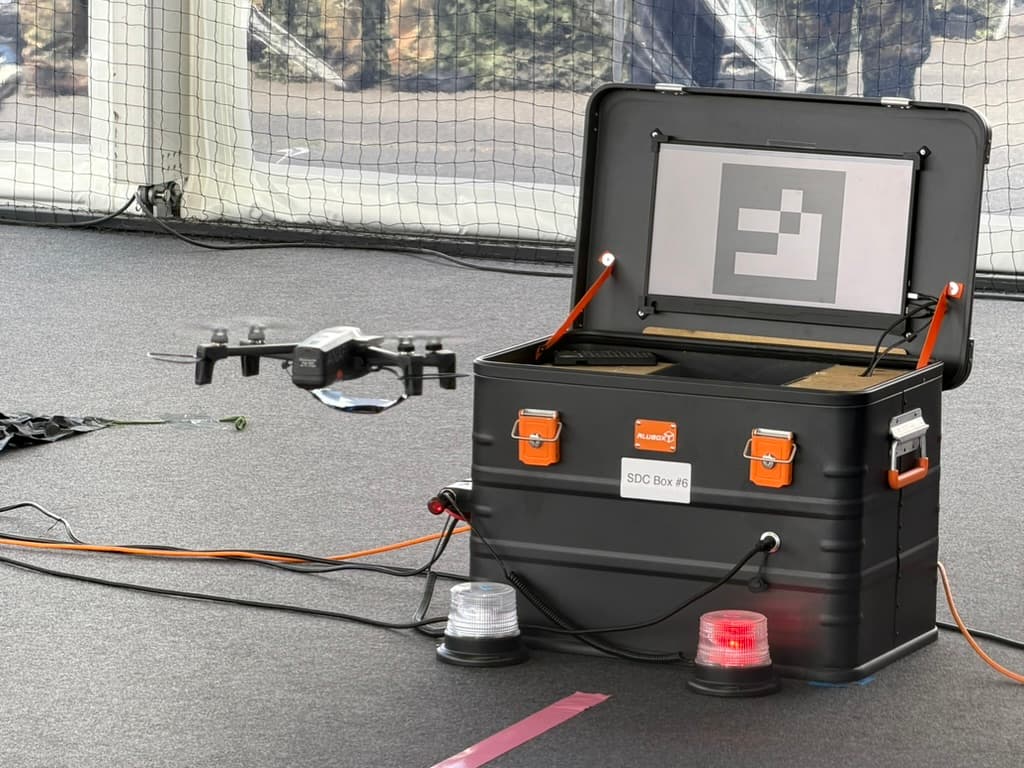
What happens when a team of software and AI experts — who had never touched a drone — go up against the defence industry's best? They almost win.
Last week at ILA Berlin 2026, our team tobedefined placed 2nd in the MBDA & brigkAIR Swarm Drone Challenge, the first live competition for fully autonomous drone swarms ever held at the show. We did it against a field of seasoned defence-industry teams — and we did it in 3.5 months, starting from zero.
This is the story of how we got there, and what it proves about how software gets built today.
The challenge: autonomous swarms playing capture the flag
The Swarm Drone Challenge is exactly as hard as it sounds. Two swarms of drones face off in a "capture the flag" scenario: each swarm has to capture the enemy's target boxes while defending its own — completely autonomously. Once the match starts, no human flies anything. The software reads the situation, decides the strategy, and executes the tactics live on the field.
That means building the full stack: flight controllers, a command-and-control (C2) server, and resilient communication with and between the drones. Sensing, coordination, swarm logic, failure handling — all of it has to work together, under pressure, in real time.
Starting from zero
In February, Vicki Lichtenegger assembled a team of five seasoned IT and AI experts. Between us we had decades of software and AI experience — and exactly zero experience with drones or the defence industry.
We didn't see that as a disadvantage. We saw it as an experiment: how far can AI take a strong engineering team into an unfamiliar, highly specialised domain — and how fast? Not just the coding, but the architecture, the strategy, the whole structure of the project.
Three and a half months later, we had a working autonomous drone swarm.
The result: 2nd out of a field of experts
We finished 2nd, behind Team Flying Algorithm — a team in a completely different league. They brought six years of drone-swarm experience, members working actively in the drone industry, and one who wrote his PhD thesis on drones. Against that depth of expertise, a team that didn't exist five months ago came second.
We're not pretending we beat the specialists at their own game. We didn't. But we got close enough to make the point that matters.
What actually made the difference: speed
The competition turned into a live demonstration of how fast AI-assisted development now moves. Two moments tell the whole story:
Two days before the finals, we rewrote our entire C2 server from scratch — with Claude. A rebuild of a core system that would traditionally be unthinkable on that timeline became a focused, single-session effort.
Fifteen minutes before the semi-final, we added a new capability: recovery of crashed drones. It became decisive. During the match, that last-minute function revived our crashed units and kept us in the fight.
This is what "100x faster" looks like in practice. Work that used to take teams months — or require years of accumulated domain experience to even attempt — collapses into days and minutes when experienced engineers pair with AI.
The honest caveat: AI doesn't replace foundations
Here's the part that's easy to skip and shouldn't be. AI made us fast, but it didn't make us a team that could run this project. You still need experienced people who know how to scope a hard problem, make architectural decisions, judge what the AI produces, and hold a project together when it's under pressure.
The 100x speed-up is real — but it multiplies judgment, it doesn't substitute for it. Drop AI into a team with no foundations and you get fast nonsense. Drop it into a team that knows what it's doing and you get a serious autonomous drone swarm in 3.5 months.
That combination — experienced experts, amplified by AI — is exactly the bet we're making.
Where we go from here
We came away from ILA grateful — for the experience, the learnings, and the proof of what's possible.
tobedefined carries that forward. We work as an external task force: an experienced team that comes into your company, uses AI to compress timelines dramatically, and delivers working software in weeks — without the typical corporate red tape. No endless discovery phases, no bloated process. Just experienced engineers, AI leverage, and shipped software.
If your organisation has a software project that's been stuck in the queue, or a problem everyone assumes needs a year and a specialist team, we'd like to talk.
www.tobedefined.ai — Fast Software. Any Domain.
Watch our story: youtu.be/XNUptnn5DJQ
Ready to put this into practice?
Get our free China sourcing whitepaper or book a free consultation — no strings attached.